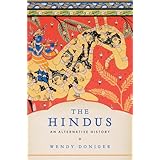
Average Reviews:

(More customer reviews)Are you looking to buy The Hindus: An Alternative History? Here is the right place to find the great deals. we can offer discounts of up to 90% on The Hindus: An Alternative History. Check out the link below:
>> Click Here to See Compare Prices and Get the Best Offers
The Hindus: An Alternative History ReviewAs someone who has grown up in an academic environment, I would like to think of myself as catholic in my outlook; but this book by Wendy Doniger was just off.To start with I maintain two gold standards of writers from the west
writing on India. The first is Heinrich Zimmer who wrote 'Myths and
Symbols in Indian Art and Civilization' which I have gone back to
repeatedly over the past 20 years. The other is the works of William
Dalrymple and the work of his that I cherish the most is one titled
'White Mughals'.
The former is a scholar who has sought to deeply understand Indian culture and the myths it has evolved and the latter is a fine writer first and foremost with a keen eye and love for all things Indian.
But what really makes their writings classic that wants me to go back
to them repeatedly is their generosity of spirit and largeness of
heart. They do not shy away from the warts, but you know what is
driving them to research and write their material is a genuine desire
to understand and the joy of discovery.
That brings me to Ms Doniger. When I came upon the book after reading a review of it in the NY Times, I rubbed my hands in glee. Ah, here is a book I thought to myself, that is going to present new and important insights, from a seasoned philologist, that is going to enhance
one's knowledge of Indian culture in new and important ways (good or bad - no matter).
What Wendy Doniger does do is that she applies all the tools and techniques and filters of 20th and 21st century social and cultural analysis to bear upon circa 500 BC India and then proceeds to sit in judgment. But it turns out that no wart is unworthy of examination and it is warts that are examined!
As an example, I opened the chapter on the Upanishads with a degree of anticipation hoping that a sociological context to the content of the Upanishads is going to present new insights. To one's great disappointment there is nothing on the sheer poetry of the verse or the metaphysics therein. Rather the good professor takes one or two of the Upanishads and
proceeds to see male chauvinism and cruelty at every turn.
Really, that's what she got out of the Upanishads? For example how about the Ananda Valli Kanda of the Taittiriya Upanishad - which defines
happiness. Not a word on that. How about the psychological complexity unveiled in the Mandukya Upanishad? Not a word on that. As someone who has lapped up all sorts of commentaries on the Upanishads for many years now (all takes welcome), this one was astonishing primarily for its wholly missing the point!
Doniger's pettiness contrasts with the generosity of spirit I have
mentioned above. Two examples here. She has comments to make on the
Ramayana and the Mahabharatha. She writes, introducing them,
'considered by some as epics'. Really? Only some people consider these epics? I am all open and eager for scholarly analysis of any subject matter - but throw us a bone here (more on dogs later...!) - give the Indians their epics!
Another example in the same vein. She reference Shankara later in the
book and while describing him as the founder of the Shankara Matts
/Schools. She in paretheses writes 'is said to have founded'. Again,
really? If the Professor doubts that Shankara founded the Matts, I am
very interested in knowing about this! Even if it is vague conjecture, tell me more - I fully agree that Indian history can be vague, so please throw some light. But instead of exploring the justifiable debate or controversy that exists, she just has a throw away line, for apparently no reason.
The attitude that comes through is one of hostility, contempt and
shoddy writing. And the dogs. There are several hundred references to Indian
view of dogs. Whats with that? I am a pet owner myself and
love my dog. But this was so discordant that I was just not getting it.
There is also a chapter on Hindus in America. This section is so superficial that it is laughable. It feels like the author has browsed a couple of websites and found that enough to channel her points of view.
A final note on sex. A three thousand year old mature civilization has seen a lot in its ebbs and flows and the land of the Kama Sutra is
going to have its share of views. But Doniger sees hostile,
vituperative sexual mores at every turn, even when such an
interpretation is not warranted.
A metaphor I want to use for Wendy Doniger is the following. When I
was a kid, visiting my grandmother in Hyderabad, India, I would love
going to the 'sugar cane stand'. There the sugar cane wallah would
take the sugar cane stems and crush them through two rollers and
collect the juice into a cup. On a sunny summer day it was the best
drink ever. Then all the crushed pith would go into a rubbish pile on
the ground.
Heinrich Zimmer and William Dalrymple get to the sugar cane juice.
Wendy Doniger rakes about in the sugar cane pith with no concept of
what the juice is all about.
Does this mean that I do not recommend you read this book. Not at all. I am not one to shy away from a variety of perspectives or debate. So please do pick it up from the library and give it a glance. Just don't expect to walk away from it with new insights other than the fact that the author has an agenda and Indian culture happens to serve it in this case.
The Hindus: An Alternative History OverviewFrom one of the world's foremost scholars on Hinduism, a vivid reinterpretation of its history An engrossing and definitive narrative account of history and myth that offers a new way of understanding one of the world's oldest major religions, The Hindus elucidates the relationship between recorded history and imaginary worlds. Hinduism does not lend itself easily to a strictly chronological account: many of its central texts cannot be reliably dated even within a century; its central tenets—karma, dharma, to name just two—arise at particular moments in Indian history and differ in each era, between genders, and caste to caste; and what is shared among Hindus is overwhelmingly outnumbered by the things that are unique to one group or another. Yet the greatness of Hinduism—its vitality, its earthiness, its vividness—lies precisely in many of those idiosyncratic qualities that continue to inspire debate today. Wendy Doniger is one of the foremost scholars of Hinduism in the world. With her inimitable insight and expertise Doniger illuminates those moments within the tradition that resist forces that would standardize or establish a canon. Without reversing or misrepresenting the historical hierarchies, she reveals how Sanskrit and vernacular sources are rich in knowledge of and compassion toward women and lower castes; how they debate tensions surrounding religion, violence, and tolerance; and how animals are the key to important shifts in attitudes toward different social classes. The Hindus brings a fascinating multiplicity of actors and stories to the stage to show how brilliant and creative thinkers—many of them far removed from Brahmin authors of Sanskrit texts—have kept Hinduism alive in ways that other scholars have not fully explored. In this unique and authoritative account, debates about Hindu traditions become platforms from which to consider the ironies, and overlooked epiphanies, of history.
Want to learn more information about The Hindus: An Alternative History?
>> Click Here to See All Customer Reviews & Ratings Now

0 comments:
Post a Comment