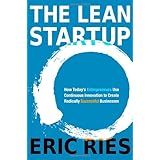
Average Reviews:

(More customer reviews)Are you looking to buy The Lean Startup: How Today's Entrepreneurs Use Continuous Innovation to Create Radically Successful Businesses? Here is the right place to find the great deals. we can offer discounts of up to 90% on The Lean Startup: How Today's Entrepreneurs Use Continuous Innovation to Create Radically Successful Businesses. Check out the link below:
>> Click Here to See Compare Prices and Get the Best Offers
The Lean Startup: How Today's Entrepreneurs Use Continuous Innovation to Create Radically Successful Businesses ReviewAs an experienced entrepreneur - inside of big companies in terms of the ubiquitous "change initiative," but also in new product or service development, and as a new subsidiary C-level executive - and now as a small business startup founder and owner - I really looked forward to reading this. Unfortunately, as much as I wanted to like this book and see how I could apply Ries' learnings to better my entrepreneurship and my innovation, I was deeply disappointed. The book is repetitive, light on specifics, with many generalized insights (that are really not too insightful), and even includes a number of passages that lead the reader to second-guess whether the author's point is to share actual advice and steps to take, or to encourage people to use his "Lean Startup program" (which, coincidentally, entails hiring his firm - who knew?).Six key strengths/pros of the book:
1. It's a very quick read; I finished it in two sessions
2. A great premise: "the application of lean thinking to the process of innovation"
3. An excellent threshold question that goes beyond the usual, Should this product be built? to: "Can we build a sustainable business around this set of products and services?" Definitely more would-be entrepreneurs should be able to definitely answer this question long before they go seek funding or decide to incorporate.
4. The suggestion to see customer requests/desires as the opportunity to run innovation experiments, not as the actual need for a new product or service (i.e., maybe you only need to tweak a current product or service, not invent new). For anyone who's followed Voice of the Customer new product innovation techniques over the past two decades, this is hardly news, but Ries does a good job of simplifying one of the core learnings of Voice of the Customer: stated customer feedback is not always an accurate reflection of actual need/desire.
5. The concept of the "engines of growth" (i.e., entrepreneurs have lots of ideas, it's really more a matter of selecting which ones will actually work and strongly grow the company).
6. The need to use metrics of customer churn rate versus customer retention versus new customer attraction to assess customer behavior associated with your product/service, and thus the likelihood for good business growth.Four frustrating cons of the book:
1. Mr. Ries must mention at least a dozen times throughout the book (and sometimes several times a chapter) something along the lines of "My experiences are now part of the entrepreneurship curriculum at several business schools, including Harvard Business School, where I serve as an entrepreneur in residence. I've also told these stories at countless workshops, lectures and conferences." It's one thing to tell stories in a book to demonstrate principles and tactics, it's another to constantly remind the reader about the great stories and advice he/she is getting by reading the book.
2. All of the strengths I noted above are just about how specific Mr. Ries actually gets. For instance, over pages 215-220, Ries discusses the metrics of customer churn, customer retention, and how, in order to get good growth, you have to have significantly more customer retention and more new customers than lost customers. At the end of those five pages, you'll have learned exactly what I just stated (and in the process read a bunch of stories and case studies taught in countless workshops, etc., illustrating that sentence).
3. A number of the mistakes that Mr. Ries talks about are related to his dot-bomb experiences, and do not, unfortunately, relate very well to innovators and entrepreneurs today. For instance, most of the venture capitalists that I know will not loan money or invest in startups that do not have rock-solid business plans stating specifically how the new product or service will make money, how quickly, the specific known hurdles, and so on. And the VCs will re-run their own numbers and do their own market analysis. Try getting a line of credit today, and you'll quickly see how different the financial investment in the startup landscape is today from back in the dot-bomb era.
4. Much of the book is written not for small business owners or those who'd strike out on their own and start a new company, but those who work within large companies (who, incidentally, will have the money to hire Mr. Ries as an entrepreneurship consultant) and want to start innovating better, being more creative, and being internal entrepreneurs.
While these pros and cons balance out any assessment of the book (and thus I give it 3 stars), I don't think they make for a satisfying - or even very helpful read. There's much better fare out there that is much more specific, including the Heath brothers' "Made to Stick" or their latest, "Switch."
If you must get "The Lean Startup," wait for it in the bargain bin.The Lean Startup: How Today's Entrepreneurs Use Continuous Innovation to Create Radically Successful Businesses Overview
Most startups fail. But many of those failures are preventable. The Lean Startup is a new approach being adopted across the globe, changing the way companies are built and new products are launched. Eric Ries defines a startup as an organization dedicated to creating something new under conditions of extreme uncertainty. This is just as true for one person in a garage or a group of seasoned professionals in a Fortune 500 boardroom. What they have in common is a mission to penetrate that fog of uncertainty to discover a successful path to a sustainable business. The Lean Startup approach fosters companies that are both more capital efficient and that leverage human creativity more effectively. Inspired by lessons from lean manufacturing, it relies on "validated learning," rapid scientific experimentation, as well as a number of counter-intuitive practices that shorten product development cycles, measure actual progress without resorting to vanity metrics, and learn what customers really want. It enables a company to shift directions with agility, altering plans inch by inch, minute by minute. Rather than wasting time creating elaborate business plans, The Lean Startup offers entrepreneurs - in companies of all sizes - a way to test their vision continuously, to adapt and adjust before it's too late. Ries provides a scientific approach to creating and managing successful startups in a age when companies need to innovate more than ever.
Want to learn more information about The Lean Startup: How Today's Entrepreneurs Use Continuous Innovation to Create Radically Successful Businesses?
>> Click Here to See All Customer Reviews & Ratings Now

0 comments:
Post a Comment